Laser hair removal. Face to full body, in Calabasas.
Laser hair removal near Calabasas — face, Brazilian, underarms, legs, back and full-body courses. Sessions, spacing, and skin-type fit.
A course of laser sessions that disables hair follicles for long-term reduction — on the face, underarms, bikini line, legs, back, or the full body. The light is absorbed by pigment in the hair and converted to heat at the follicle. Most areas take six to eight sessions spaced four to eight weeks apart, performed at our Calabasas studio.
Melanin, heat, and the growth cycle.
Laser hair removal works by selective photothermolysis — light at a wavelength absorbed preferentially by the melanin in the hair shaft. The energy travels down the shaft, converts to heat at the follicle, and disables the structures that regrow the hair, while the surrounding skin, carrying less pigment than the hair, stays largely unaffected. The treatment depends on that contrast, which is why dark hair responds best and why blonde, red, gray and white hair — with too little melanin to absorb the energy — don't respond at all.
Hair grows in cycles, and only follicles in the active growth phase — anagen — hold a shaft that conducts the laser's energy down to the structures worth treating. At any given moment, roughly a third of the follicles in an area are in anagen; the rest are resting or shedding, and a pass over them accomplishes nothing. One session, however thorough, can only ever treat the cohort that happens to be growing that day.
That cycle is the whole reason a course is spaced the way it is. Sessions sit four to eight weeks apart — closer on the face, where the cycle turns faster, further out on the body — so each visit catches a fresh cohort of follicles entering the growth phase. Compressing the schedule doesn't speed the result. It treats the same follicles twice.
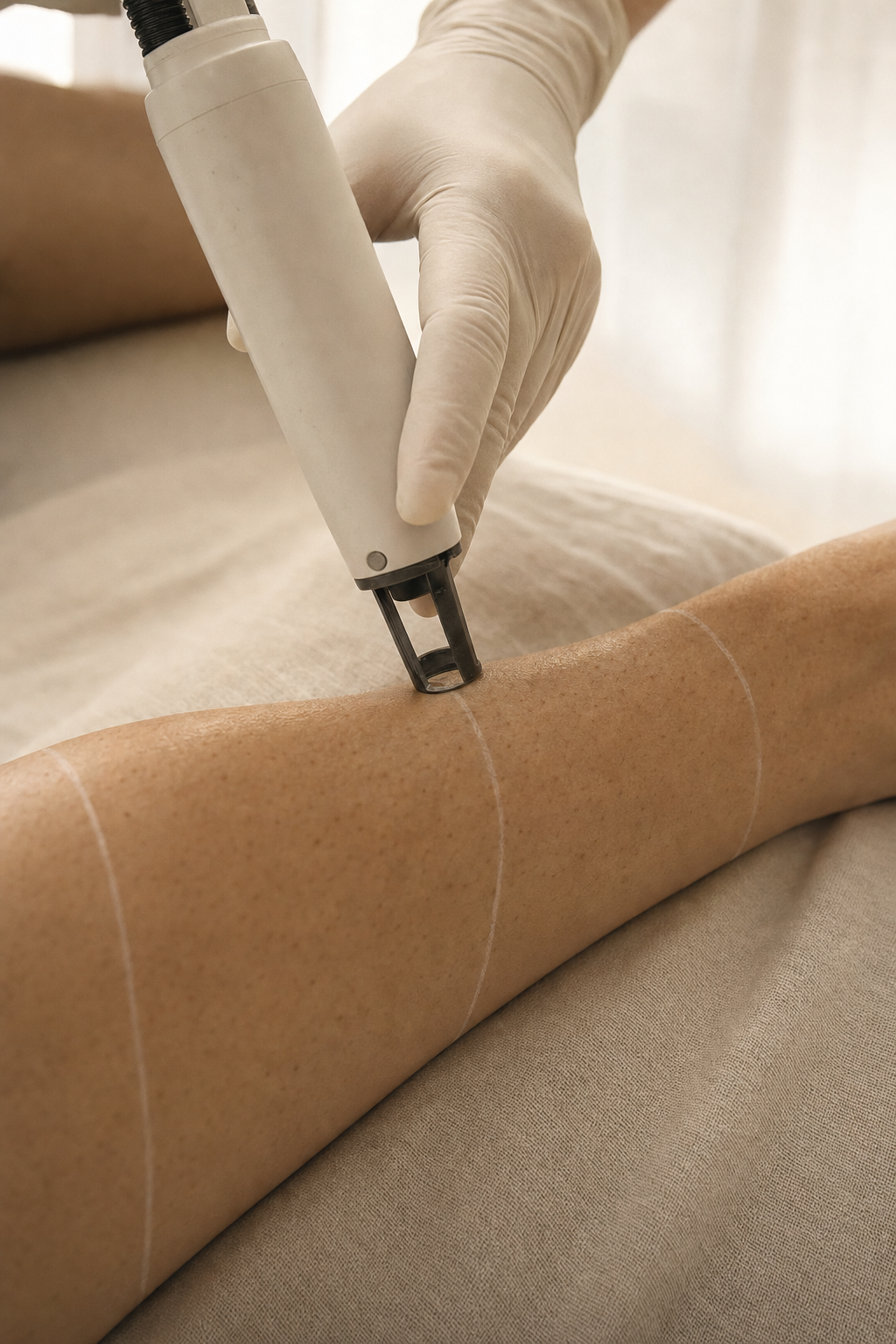
We don't quote a device model on this page, deliberately. The platform and settings are confirmed at consultation, matched to your Fitzpatrick type and hair color rather than promised in the abstract. The match matters most in darker skin tones, where the safe approach is a wavelength that reaches the follicle without overheating the pigment in the skin itself — if you're Fitzpatrick IV through VI, that conversation happens candidly at the consult, including whether laser is the right tool for your hair at all.
Face to full body. Priced by area.
Each area is priced per session by surface and density, and quoted in writing at consultation — typical Los Angeles market ranges are in the FAQ below for orientation. Most patients combine two or three areas per visit.
| FaceUpper lip · chin · sideburns | Short sessions — often under twenty minutes — on the areas where waxing is most visible and most punishing. Facial hair cycles faster than body hair, so spacing sits at the four-week end, and hormonally driven facial hair can need a longer course and honest expectations. |
|---|---|
| Brazilian / bikiniBikini line through full Brazilian | The scope is defined with you at consultation. Coarse, dark hair responds especially well here. Topical numbing is available; most patients describe the sensation as a brief hot snap and tolerate it without. |
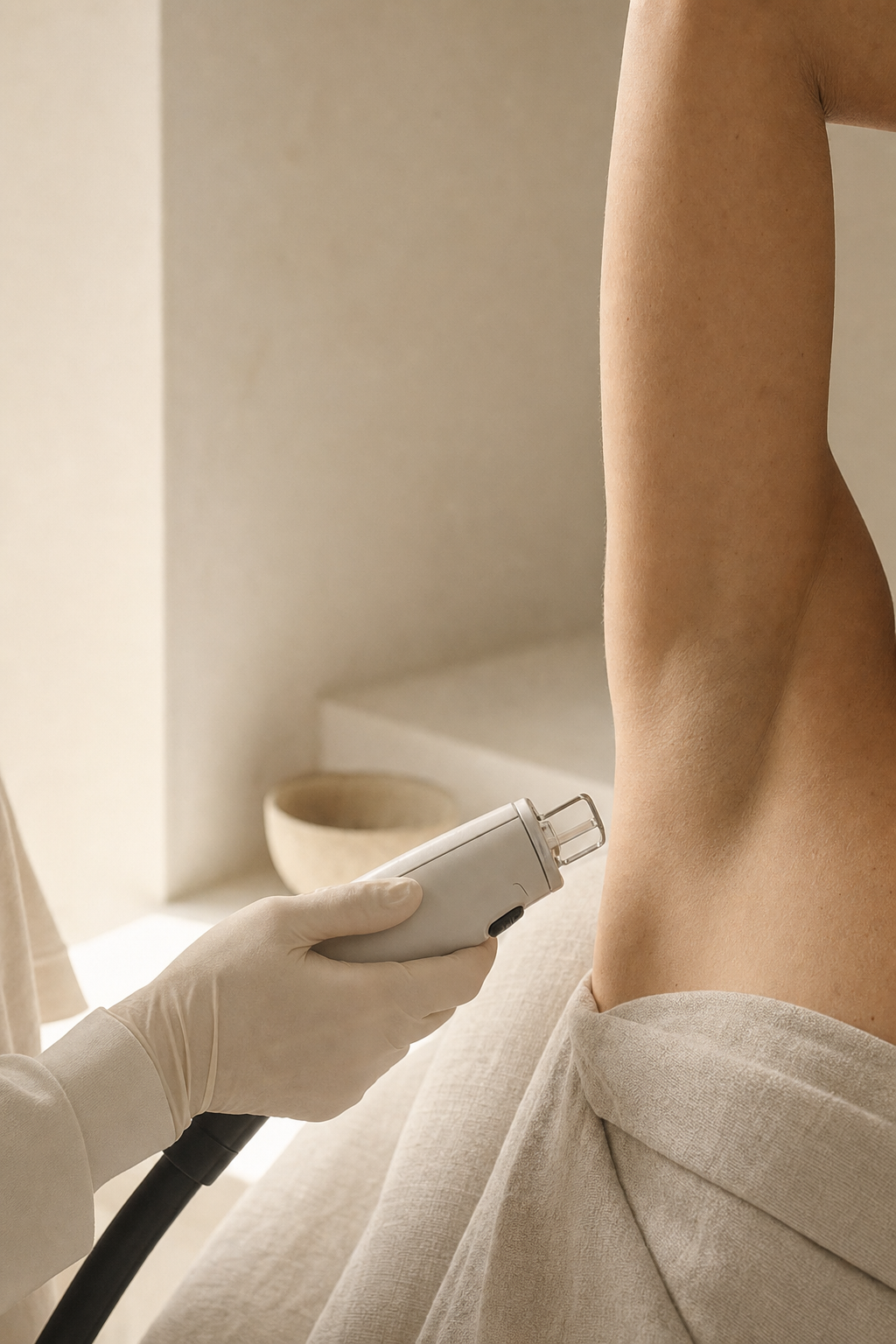
| UnderarmsThe quickest area on the menu | Roughly ten minutes a session, and one of the most satisfying areas for the effort. Almost always combined with another area in the same visit. |
| LegsLower or full | The largest standing commitment after the back. Sessions are longer and spacing sits at the six-to-eight-week end, because body-hair cycles turn more slowly than facial ones. |
| BackCovered in depth on its own page | Coarse, dense, and demanding enough that we keep a dedicated page on it — device considerations, session structure, and the pre-care that decides whether a back course works. See the back-specific page linked below. |
| Full-body coursePlanned as one program | A scheduled rotation across areas, sequenced so each one keeps its own cycle timing. Priced as a course rather than a stack of single areas; the structure is set out in writing at consultation. |
From patch test to maintenance.
Most areas run six to eight sessions. The shape of the plan, first visit to last:
- 01
Consultation and patch test.
Fitzpatrick classification, a direct check of hair color and density, medication and medical history. For darker skin types — or any uncertainty — a test patch on a small section at the planned settings, reviewed before the first full session. You leave with a written plan: areas, sessions, spacing, pricing.
- 02
Sessions 1 – 3 · the density thins.
Shave the area the day before each visit. Each pass treats the follicles currently in the growth phase; most patients see density visibly thinning by the third session. Mild redness and perifollicular puffiness for 12 – 48 hours afterward is normal.
- 03
Sessions 4 – 6+ · the stragglers.
Spacing holds at 4 – 8 weeks depending on the area — shorter on the face, longer on the body. What remains grows back finer and lighter; coarse, dense areas like the back typically run the full eight sessions.
- 04
Maintenance, honestly.
Laser hair removal is permanent reduction, not permanent removal — the FDA labeling reflects exactly that distinction. Most patients return once or twice a year for a touch-up on whatever regrowth appears, often hormonally driven.
What you do between visits decides the result.
No waxing, plucking, or threading between sessions — at all. The laser targets the pigment sitting in the follicle, and a follicle that's been emptied by wax has nothing left to absorb the energy. Shaving is the one removal method compatible with a course, because it leaves the shaft below the surface intact. Shave the area the day before each session, not the morning of, and we'll address any missed sections at the visit.
Sun exposure is the other lever. A tan narrows the contrast between hair and skin that the laser depends on and raises the risk of pigment change, so four weeks of strict sun protection — no tanning, no self-tanner — precedes every session. We'd rather defer a session than treat through a tan, and we do.
Afterward: cool the area, skip hot showers, the gym and the sauna for 24 hours, and keep daily SPF on any treated skin that sees sun for the following month. None of it is onerous. All of it shows up in the result.
Supervised by Dr. Charles Peterson, board-certified physician with nearly a decade in aesthetic medicine.
Questions we get.
How much does laser hair removal cost?
In the Los Angeles market, small facial areas typically run $75 – $250 per session, underarms $100 – $250, Brazilian $150 – $350, legs $250 – $600, and the back $300 – $600; full-body sessions commonly run $600 – $1,200. Total cost scales with session count — typically six to eight per area. Our pricing is discussed at consultation and quoted in writing before you book.
Does it hurt?
Most patients describe a brief hot snap with each pulse, taken down considerably by the chilled handpiece. The Brazilian and the upper lip are the most sensitive areas; topical numbing is available for both. Nobody enjoys it; almost everybody tolerates it without numbing.
Does it work on darker skin?
Yes, with the right wavelength and conservative settings — which is precisely what the consultation and test patch establish. The unsafe version is a device matched to the clinic rather than to the patient. We classify Fitzpatrick at consultation and tell you candidly what's appropriate for your skin.
How many sessions will I need?
Six to eight for most areas, spaced four to eight weeks apart — faster-cycling facial areas at the shorter interval, coarse dense areas like the back at the longer. Hormonally driven hair growth — some PCOS presentations, patients on testosterone therapy — often needs more.
Is laser hair removal permanent?
Permanent reduction, not permanent removal — that's the honest framing, and the FDA's. Follicles treated in their growth phase don't regrow, but hormones recruit new ones over the years. Most patients hold their result with one or two touch-up sessions a year after the course.
Can I do laser hair removal while pregnant?
No. We defer hair removal through pregnancy and breastfeeding. Pregnancy also commonly shifts hair growth on its own, so the plan is more accurate once things have settled — we hold your course and resume the cadence afterward.
Continue.
Ablative resurfacing, pigment, vascular, RF, hair removal, tattoo and PMU removal — how we choose by concern, not by device.
Device selection for the back, session count, anagen-cycle timing, and pre-care that affects whether the session works.
Pores, fine lines, tone unevenness, crepiness and laxity — a layered approach using regenerative microneedling, lasers and peels.
Schedule a consultation for laser hair removal. face to full body, in calabasas.
“I had ablative CO2 laser resurfacing. Next to no pain! … She explained everything in detail and was explicit in after care instructions…”