RF microneedling. Collagen induction therapy explained.
Microneedling with radiofrequency heat for mild laxity, acne scars, and large pores. How it compares with Morpheus8 and basic microneedling.
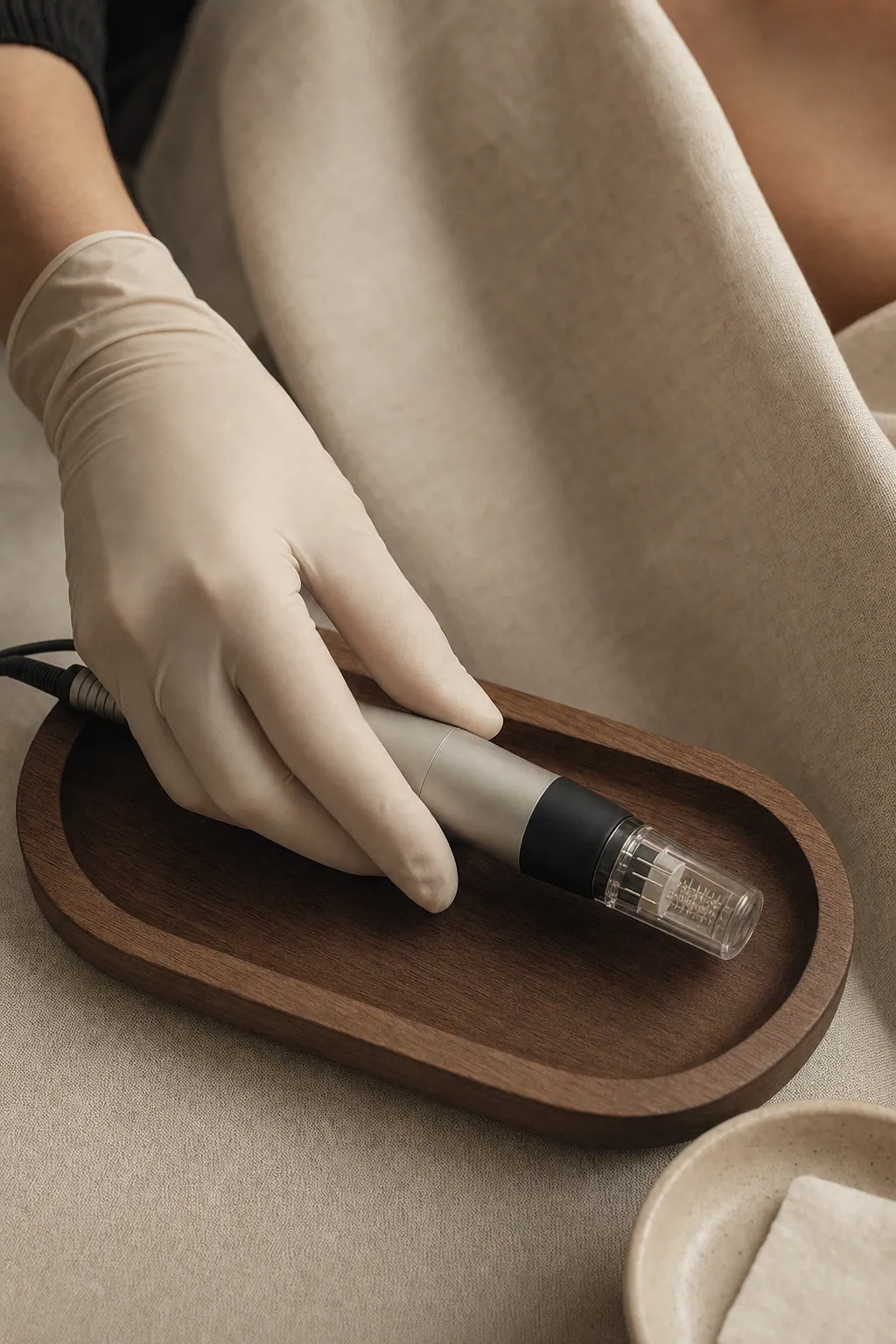
Microneedling that pairs the standard needling injury with bipolar radiofrequency energy delivered through the tips of the needles. The needles create channels; the RF energy heats the dermis around each channel to a controlled temperature for a controlled time. The result is a measurably stronger collagen response than needling alone — and a category overlap with Morpheus8, which is one specific RF microneedling device.
Two mechanisms in one pass.
Standard microneedling is a mechanical injury — pin the skin, let it heal. RF microneedling adds a second injury, thermal, delivered through the same channels. Bipolar radiofrequency energy travels between the tips of paired insulated needles, heating the surrounding dermis to roughly 65–70°C for a fraction of a second. The heat denatures existing collagen and triggers a more aggressive remodeling response than needling alone.
The mechanical channel and the thermal coagulation zone are tuned independently. Depth is set by the needle length (typically 1 to 4 mm); energy is set by the device's RF parameters. A trained operator chooses both for the area being treated — shallow and lighter on the cheek, deeper and warmer at the jawline.
Because the heat is dermal and not epidermal, the surface heals faster than CO₂ resurfacing for a comparable remodeling effect underneath. The trade-off: RF microneedling is less aggressive on photodamage and surface texture than fully ablative resurfacing.
The indications that respond best.
RF microneedling is the right answer when the patient's primary concerns are mild skin laxity (especially around the jawline and lower face), atrophic acne scarring (rolling and boxcar types), enlarged pores, and overall skin tightening short of a surgical lift.
It's not the right answer for melasma, vascular concerns, or fine epidermal pigment — those are better-served by pigment lasers, vascular lasers, or non-thermal microneedling with PDRN. It also doesn't replace a face lift; it works in the gap between regenerative microneedling and an operating room.
Where RF microneedling sits.
Three treatments that get conflated in marketing materials but do meaningfully different work. The differences below drive which one we recommend.
| Microneedling (SkinPen) | RF microneedling | Morpheus8 | |
|---|---|---|---|
| What it is | Mechanical micro-channels only | Mechanical channels + bipolar RF heat | A specific RF microneedling device (InMode) |
| Best for | Texture · fine lines · early aging | Mild laxity · acne scars · pores | Same as RF microneedling, with a particular depth range |
| Depth | 0.5 – 2 mm | 1 – 4 mm, settable | Up to 4 mm with proprietary tips |
| Heat involved | None | Yes — dermal coagulation zones | Yes — same category |
| Downtime | 1 – 2 days | 3 – 5 days | 3 – 5 days |
| Sessions | 3 – 4 | 3 – 4 | 3 – 4 |
It's a device, not a category.
Morpheus8 is a specific RF microneedling device manufactured by InMode. It's well-marketed, well-trained-on, and clinically capable — but it isn't a separate treatment category. "Morpheus8 vs RF microneedling" is a question about which RF microneedling device, not whether to do RF microneedling at all.
We run an RF microneedling protocol that fits patients across the indication range. For patients who specifically asked about Morpheus8 — usually because of a friend or an influencer — we cover the comparison in detail in our journal entry at /blog/morpheus8-vs-microneedling-vs-rf/. Short version: same category, different tip geometry, similar outcomes in trained hands.
Heuristic"If the question is texture, choose SkinPen. If the question is mild laxity or scarring, choose RF. If the question is replacing a face lift, neither one is the right answer."
What happens in a session.
- 01
Consultation and mapping.
We confirm the indication, photograph the treatment area under standardized light, and mark the zones that will receive different depth and energy settings. RF microneedling is not a uniform pass — each region of the face gets its own parameters.
- 02
Topical numbing.
Compounded topical anesthetic for 30 to 45 minutes. RF sessions are warmer than plain SkinPen; numbing matters more.
- 03
The treatment.
The device is moved across the skin in overlapping stamps rather than continuous passes. Each stamp deploys the needles, fires the RF energy, retracts. Patients describe the sensation as a brief warm pressure. The treatment proper runs 30 to 45 minutes for a full face.
- 04
Cooling and recovery instructions.
Cold air or cool gauze immediately after. The skin will be flushed and slightly swollen for 24 to 48 hours. Pinpoint scabbing is normal in higher-energy zones and resolves in 3 to 5 days. Sunscreen and a bland barrier moisturizer for the recovery window.
What this can and can't do.
RF microneedling can produce a meaningful tightening of mild jawline laxity, a measurable softening of acne scars over three to four sessions, a real reduction in pore visibility, and a global improvement in skin firmness and quality. The data on collagen-type improvement is consistent across the literature.
It cannot replace a face lift. A patient with significant skin redundancy, a heavy submental fat pad, or platysmal banding will not get a face-lift result from RF microneedling — they'll get a better-quality version of their existing skin envelope, which is sometimes what they actually wanted and sometimes not. We'd rather have the candid version of that conversation up front.
It also doesn't treat melasma or active pigment well. Thermal energy on melanocyte-rich skin can occasionally drive pigment up, not down. For pigment, we recommend the pigment laser side of the menu.
- Patients with active pacemakers or implanted electrical devices in the treatment field.
- Patients within 6 months of isotretinoin (Accutane).
- Active herpes outbreak in the treatment area without antiviral prophylaxis.
- Active inflammatory acne — we treat the acne first, the scarring second.
- Patients seeking a face-lift result from a non-surgical treatment. Honest scope conversation first.
How much does RF microneedling cost in Los Angeles?
RF microneedling in Los Angeles typically ranges from $500 to $3,000 per session, depending on the treatment area. Face sessions usually run $700 to $900; neck $500 to $800; abdomen $900 to $1,000; stretch marks $500 to $850; underarm $1,000 to $1,200; thigh $2,000 to $3,000. Most plans run three to four sessions four to six weeks apart, with maintenance once or twice annually.
What drives the per-session RF microneedling price.
Treatment area is the dominant cost driver. A jawline-only RF session is a different price point than a full face. Face plus neck and décolleté scales further. Body areas — abdomen, thigh, underarm — sit at the top of the range because the treatment area is large, the pass takes longer, and the depths required are deeper than facial work.
Device used moves the price modestly. Morpheus8, Vivace, Genius RF, Profound, and similar branded devices price within a band but not identically. Patients sometimes overweight the device brand; outcomes are operator-dependent at the core, device-dependent at the margins.
Add-on topicals shift the cost. RF microneedling layered with exosomes, PRP, or PDRN runs above pure RF. The biologic add-on is priced as a separate line, and the combination is more expensive than either modality alone but often delivers more per session than two sequential treatments would.
Injector experience and location set the upper bound. Body-area RF requires significant operator skill — depths are deeper, anatomical variability is greater, and the consequences of misplaced energy can include burns or unwanted texture change. A practice with significant body-RF experience prices toward the top of the range, and the premium is meaningful.
Typical Los Angeles RF microneedling ranges by area.
Per-session pricing assumes a single area and standard depth protocol. Combined-area sessions price additively. Three-session packages typically discount the per-session total by ten to fifteen percent.
| Variant | What's included | Typical LA range |
|---|---|---|
| RF microneedling · face | Standard full-face session at variable depths matched to anatomy. | $700 – $900 per session |
| RF microneedling · neck | Neck and submental area, often paired with face in a combined visit. | $500 – $800 per session |
| RF microneedling · stretch marks | Stretch-mark resurfacing on abdomen, hips, or thigh. | $500 – $850 per session |
| RF microneedling · abdomen | Skin laxity, post-pregnancy or post-weight-loss tightening. | $900 – $1,000 per session |
| RF microneedling · underarm | Underarm laxity or focused tightening. | $1,000 – $1,200 per session |
| RF microneedling · thigh | Larger body area; deeper laxity work. | $2,000 – $3,000 per session |
RF microneedling vs CO₂ vs regenerative microneedling.
Fractional CO₂ resurfacing addresses similar texture and laxity goals on the face for $600 to $800 per session — slightly below RF microneedling per session. The tradeoff is downtime: CO₂ produces one to two weeks of visible peeling and pinkness. RF microneedling produces three to seven days of pinkness and pinpoint scabs. For patients who can't afford the social downtime, RF wins; for patients who want the fastest dramatic change, CO₂ has the edge.
Regenerative microneedling without RF runs $600 to $1,500 per session and addresses skin quality through biologic add-ons rather than thermal energy. The two modalities are often run on alternating cycles across a year — RF for laxity and texture, regenerative for quality and tone. Coordinated planning across both saves money versus assembling treatments à la carte.
For body areas, RF microneedling competes most directly with non-surgical laxity devices like Ultherapy ($2,500 to $5,000 per area) and EmFace ($800 to $1,200 per session). RF microneedling is more invasive than Ultherapy but typically delivers greater per-session change in laxity; the right tool depends on what the tissue is asking for.
Surgical alternatives — necklift, abdominoplasty, thigh lift — sit one to two orders of magnitude higher in cost and deliver permanent change. For patients with significant skin redundancy, surgery is often the better answer and we'll say so.
How we price RF microneedling.
Pricing at Swissa Med Spa is determined at consultation, where we evaluate the area and recommend a session count. The plan and total are shared in writing before booking, with multi-area combinations priced as a coordinated plan rather than separate sessions.
Supervised by Dr. Charles Peterson, board-certified physician with nearly a decade in aesthetic medicine.
Neck tightening results.
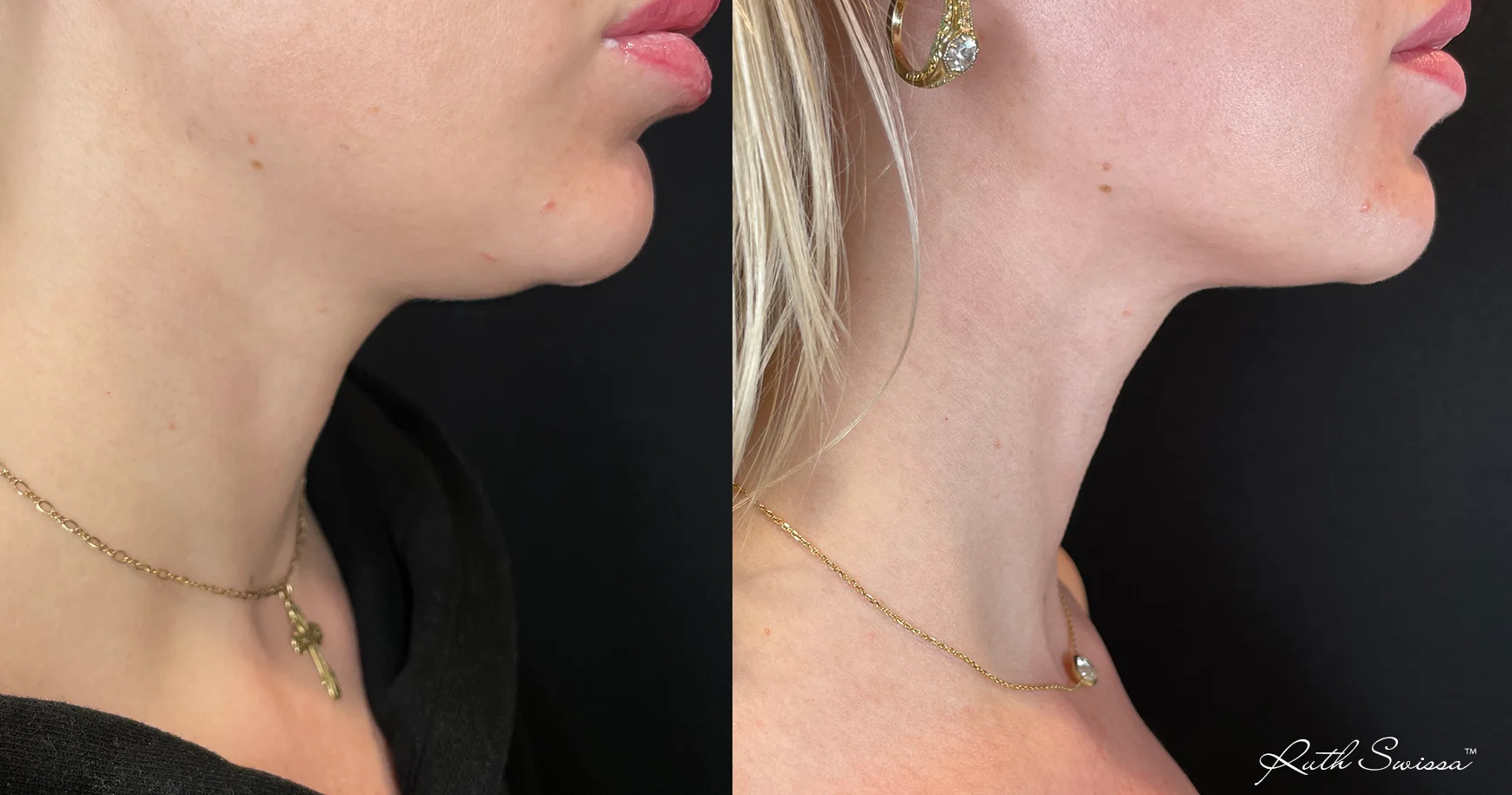
Photographs from the Ruth Swissa studio archive, shared with patient consent. Neck and jawline laxity cases shown — facial texture and acne-scar outcomes are reviewed in person.
Where rf microneedling. collagen induction therapy explained is performed.
Our Beverly Hills satellite operates Wednesdays by appointment and performs injectables only. Lasers, regenerative protocols, medical weight loss and wellness are at our Calabasas studio.
Questions we get.
How is RF microneedling different from regular microneedling?
Same needle-based delivery, but with radiofrequency heat added at the needle tips. The thermal injury drives a stronger collagen response, useful for laxity and scarring. Standard microneedling is purely mechanical and better-suited for texture refinement.
How many sessions will I need?
Three to four sessions, four to six weeks apart, is the standard initial series. Acne scarring sometimes warrants a fourth. Maintenance is typically once or twice a year after the initial series.
Can I do this on darker skin tones?
Yes — RF energy is colorblind in a way pigment-targeting lasers are not. RF microneedling is one of the safer energy-based treatments across all Fitzpatrick skin types, including IV through VI. Settings are still adjusted by tone.
How much does RF microneedling cost in Los Angeles?
Face sessions in LA typically run $700 to $900. Neck $500 to $800. Body areas climb higher: abdomen $900 to $1,000, underarm $1,000 to $1,200, thigh $2,000 to $3,000. Stretch-mark sessions run $500 to $850. Plans of three to four sessions are standard.
Does device brand (Morpheus8, Vivace) change the price?
Modestly. Branded devices price within a band but not identically; outcomes are operator-dependent at the core, device-dependent at the margins. Choosing by brand without considering injector experience often misallocates the budget.
Is this the same as Morpheus8?
Morpheus8 is one specific RF microneedling device. The category is RF microneedling; Morpheus8 is a brand within it. Outcomes are device-dependent at the margin and operator-dependent at the core. We cover the comparison at /blog/morpheus8-vs-microneedling-vs-rf/.
What's the downtime really like?
Day one: flushed and slightly swollen. Day two: still pink, makeup-friendly. Days three to five: pinpoint scabs flake off in higher-energy zones. By day five to seven, most patients are back to baseline appearance.
Can I combine it with filler or Botox?
Yes, with sequencing. We typically space neurotoxin and filler at least two weeks before or after RF microneedling. RF on top of unstable filler can warm the product unpredictably; we'd rather sequence cleanly.
Is RF microneedling more expensive than CO₂ resurfacing?
Slightly, per face session — $700 to $900 versus $600 to $800 for CO₂. The tradeoff is downtime: RF microneedling is three to seven days of social downtime; CO₂ is one to two weeks of visible peeling. Patients pick by what they can afford in time, not just in dollars.
Continue.

Microneedling layered with growth factors, exosomes, PDRN or copper peptide. What each add-on does, what it costs you in downtime.

Morpheus8 is RF microneedling — one device in the category. Three actual categories, what each one does, who they're for.
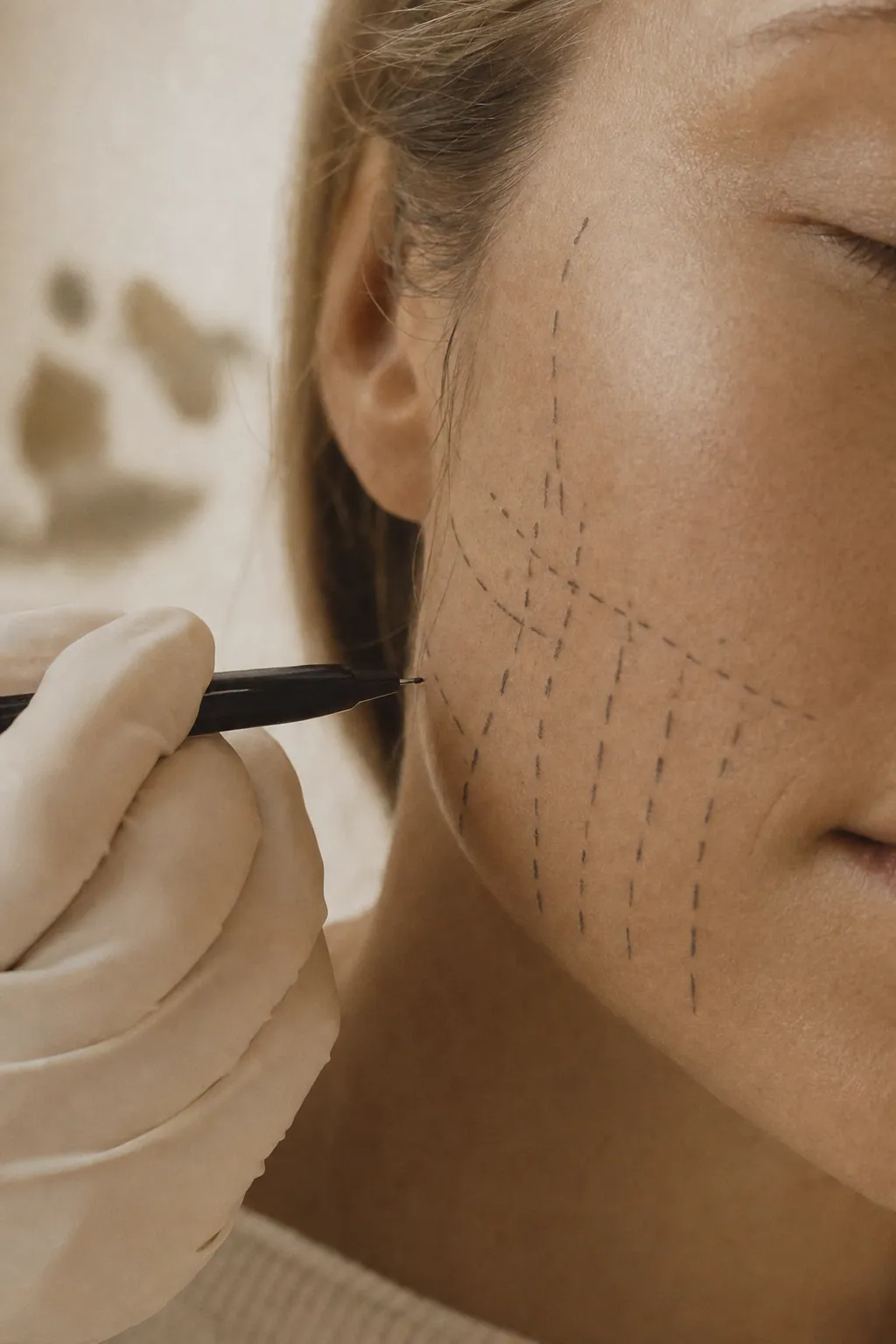
Ablative laser resurfacing for texture, pores, fine lines, crepiness and photodamage. Real downtime, Fitzpatrick caveats, recovery protocol.

Dynamic and static wrinkles — what neurotoxins, RF microneedling and resurfacing can address, and when each is the right call.
Schedule a consultation for rf microneedling. collagen induction therapy explained.
“They're truly my one-stop shop for everything beauty and skincare. The entire team is so knowledgeable, honest, and always ready to help…”