Laser resurfacing. CO₂ and Er:YAG for texture, pores, and skin laxity.
Ablative laser resurfacing for texture, pores, fine lines, crepiness and photodamage. Real downtime, Fitzpatrick caveats, recovery protocol.
An ablative laser for texture — fractional CO₂ or Er:YAG — vaporizes microscopic columns of the epidermis and upper dermis in a controlled grid, leaving untreated skin between the columns to drive rapid healing. The wound response that follows is what remodels pores, fine lines, and crepey skin. Five to ten days of social recovery for a fractional pass, longer for fully-ablative protocols; the trade is real downtime for durable, measurable change.
The five concerns this laser earns.
Skin texture is the first one, and the broadest. Atrophic acne scarring, ice-pick and rolling scars, fine lines around the mouth and eyes, photodamaged surface — these are the indications where fractional ablative resurfacing produces change that other modalities don't reliably match. If a single phrase summarizes the category, it's a laser for texture.
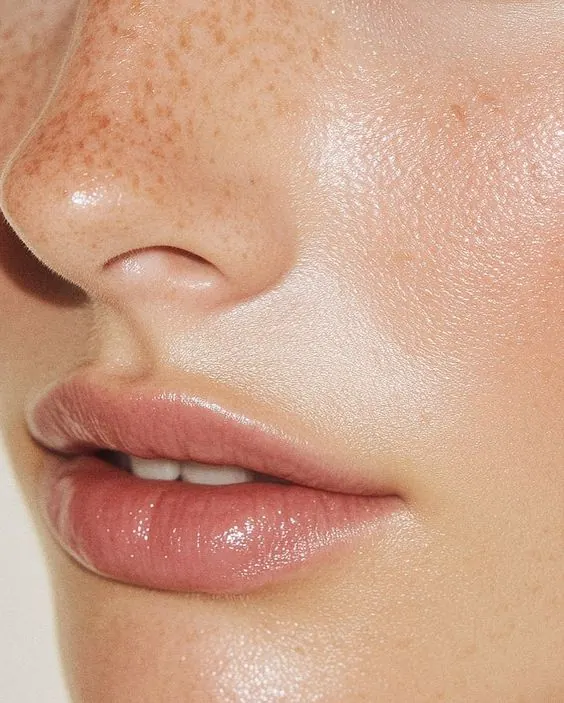
Pore size is the second. Strictly speaking, pores don't shrink — what looks larger with age is a rim of damaged collagen around each follicular opening. A pore minimizing laser works by remodeling that rim. Improvement is real, gradual, and most visible on the cheeks and nose at three to six months.
Skin crepiness is the third. Crepe-paper texture — most obvious under the eyes, on the neck, on the décolletage, and in lid skin — comes from thin, depleted dermis. A laser for skin crepiness rebuilds the collagen scaffolding underneath the surface; the smoothing follows once new collagen organizes.
Skin laxity, mild to moderate, is the fourth. Laser skin laxity work is rarely the primary lever for significant looseness — RF microneedling, ultrasound tightening, or a surgical conversation usually carries more of it — but the collagen response from a CO₂ pass does meaningful work on early jowl softening and the texture-and-laxity blend on the upper neck and lower face.
Fine lines, photodamage and pigmented sun spots are the fifth — the long tail of indications where a fractional pass refines surface quality without the downtime of a deep, fully-ablative resurfacing.
What the word "ablative" actually means.
An ablative laser removes tissue. A co2 laser at 10,600 nm and an er:yag laser at 2,940 nm are both ablative — water in the epidermis absorbs the wavelength, the tissue is vaporized in micro-columns, and the body refills the columns with new skin over the following days. Non-ablative lasers (the ones marketed as "no downtime") deliver heat into the dermis without breaking the surface; the change is gentler, and the downtime is shorter, but so is the result.
The category matters because it sets the patient's expectations correctly before the appointment. Ablative resurfacing is the treatment with real recovery and durable change. Non-ablative options exist and have a place — they're not the same procedure, they're not interchangeable, and clinics that pretend otherwise mis-set expectations.
CO₂ and Er:YAG aren't interchangeable either. The CO₂ wavelength carries more residual thermal effect, which drives a deeper collagen response and longer-lasting remodeling — at the cost of more downtime. The Er:YAG wavelength ablates more precisely with less surrounding heat, which produces refined texture work with a faster recovery, at the cost of less dermal remodeling per pass.
The laser we'll be using.
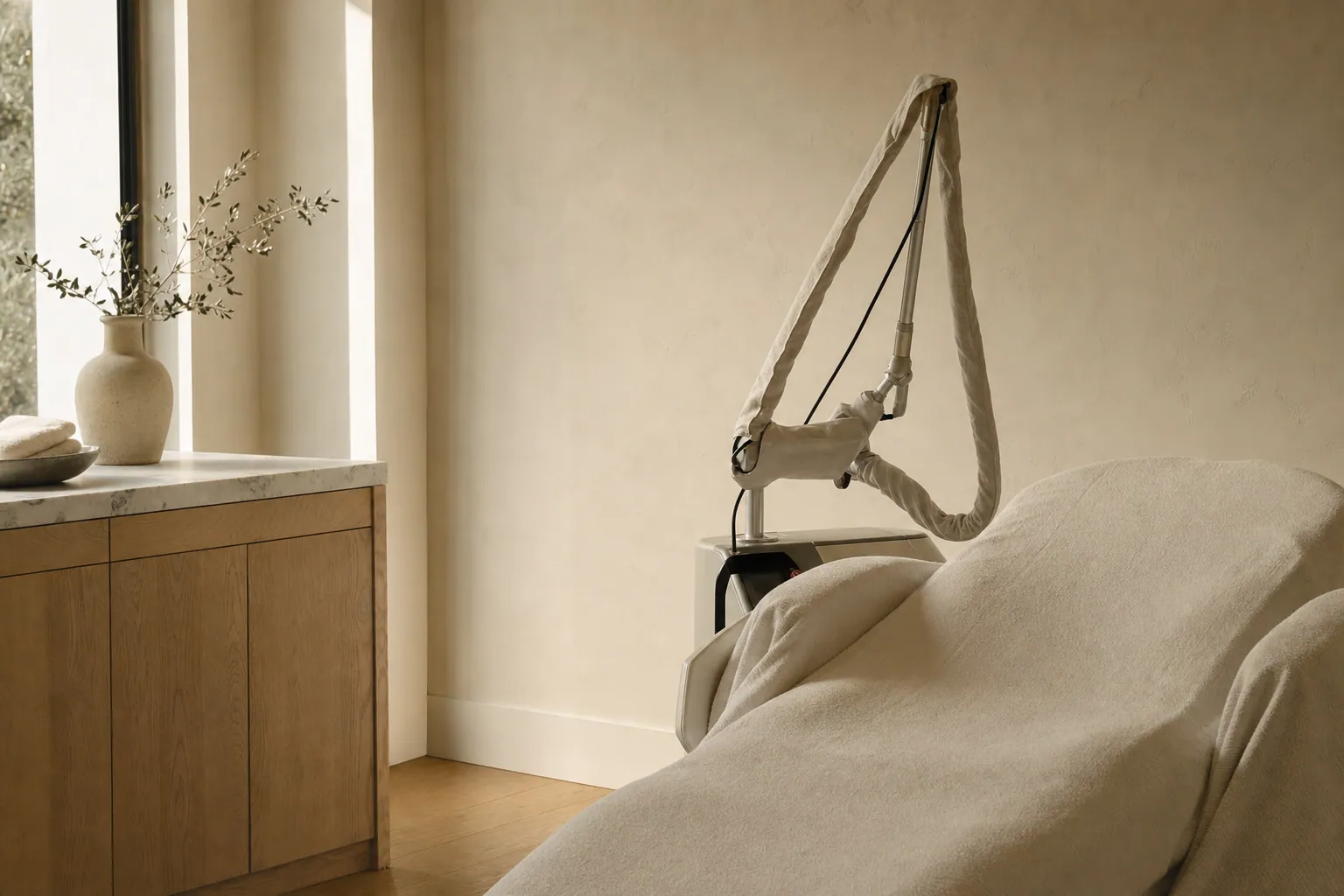
A clinic-grade fractional CO₂ device — the specific model is selected from our Calabasas laser suite based on your candidacy and the protocol depth your plan calls for. We confirm the exact device and parameters at consultation, so what's on the page now is the category, not the brand.
Two protocol depths, two recoveries.
The same device can be used in two distinctly different ways. The decision is set at consultation based on the depth of textural change, your Fitzpatrick type, and how much social recovery you can absorb.
| Fractional ablative5 – 10 days of social recovery | Microscopic columns of ablation with intact skin between them. The intact skin between the columns is what allows the surface to re-epithelialize quickly. This is the modal protocol — moderate texture, photodamage, fine lines, the surface remodeling that drives most of what patients come in for. Typically one to three sessions, three months apart. |
|---|---|
| Fully-ablative10 – 21 days of recovery | Continuous ablation of the entire treated area, used selectively for deep perioral lines, advanced photodamage, and severe atrophic acne scarring on the right candidate. Longer downtime, longer pinkness afterward (weeks to months), and a more deliberate Fitzpatrick screen. Most patients never need this; the patients who do are best served by a candid pre-treatment conversation. |
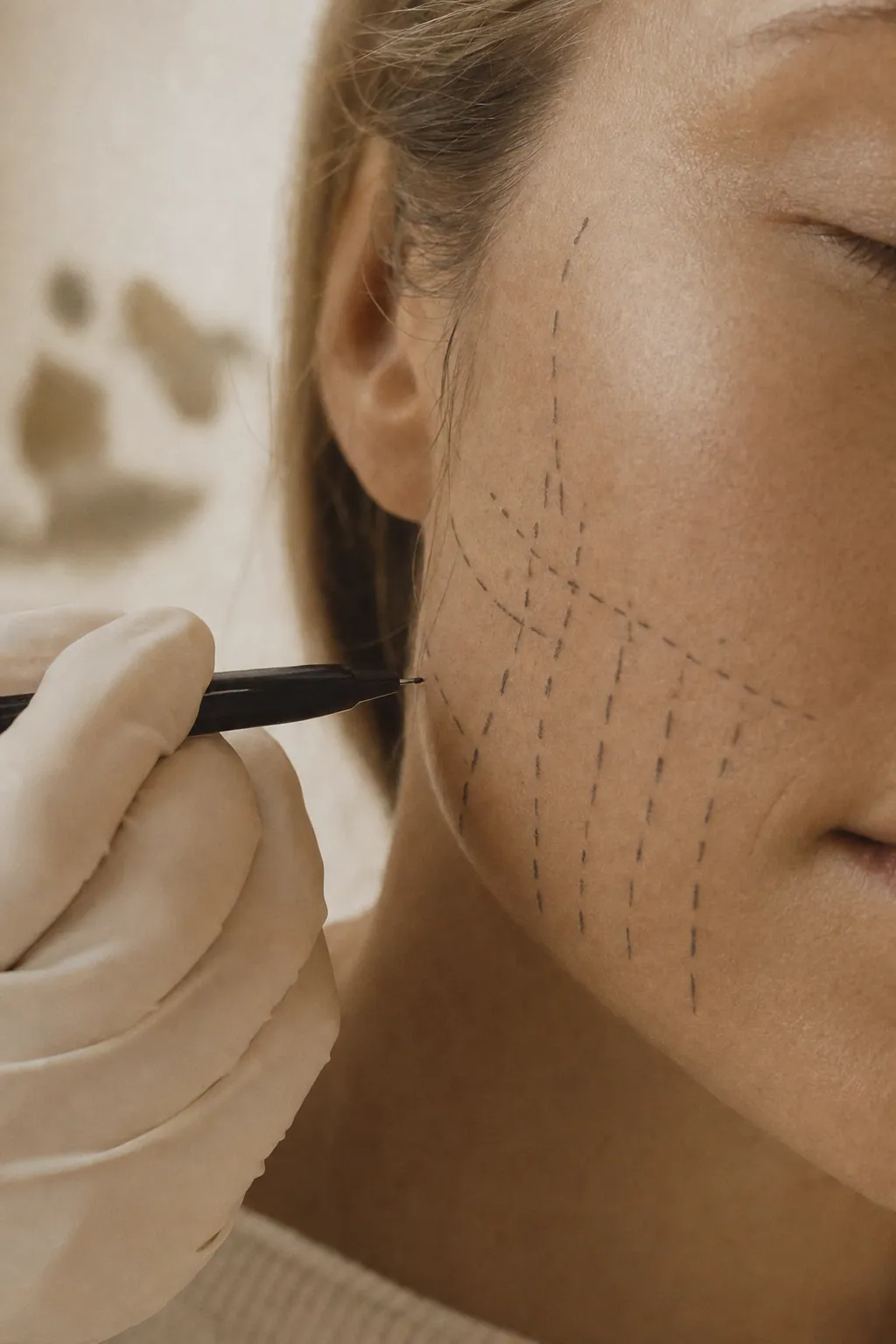
Mapping happens before the laser does.
Before any laser pass, the treatment area is mapped — the practitioner marks the regions and depths intended for each segment of the face. Cheeks, periorbital, perioral, and the lower face are usually treated at slightly different settings because the skin behaves differently across them.
Numbing — typically a topical compound applied 30 to 45 minutes ahead, sometimes with regional nerve blocks for full-face CO₂ — is part of the protocol, not an add-on. Patients are awake throughout; sensation is described as warm prickling for a light fractional pass, sharper for full-depth work.
What we will and won't do across skin tones.
Ablative resurfacing is most predictable in Fitzpatrick I through III. The post-inflammatory hyperpigmentation risk is low and the protocol parameters are well established.
In Fitzpatrick III and IV we modify the protocol. Settings are conservative, sessions are spaced further apart, and we pre-condition the skin with a tyrosinase inhibitor (typically hydroquinone or cysteamine) for four to six weeks before the first pass. Most candidates do well; the patient and the clinician should still discuss PIH risk explicitly before booking.
In Fitzpatrick V and VI, fractional Er:YAG or a hybrid non-ablative pass is usually the appropriate tool. Full-depth CO₂ in these skin types is rarely the right call, and the cases where it is benefit from a test patch and an unhurried conversation about the realistic upside and the real downside.
On Fitzpatrick"Aggressive ablative resurfacing in Fitzpatrick IV and above carries a real risk of post-inflammatory hyperpigmentation. The right plan is usually slower, not stronger."
The two weeks before the appointment.
Most resurfacing complications are preventable, and most of the prevention is in the two weeks before the laser. We'll send written pre-care; the highlights are below.
- 01
Strict UV avoidance.
No tanning, no significant outdoor exposure, no self-tanner for the four weeks before treatment. Tanned skin shifts the risk profile substantially; we defer the appointment rather than treat through it.
- 02
Pause active skincare.
Stop retinoids, AHAs, BHAs, and benzoyl peroxide one week before. Stop hydroquinone three to five days before unless we've instructed otherwise as part of pigment pre-conditioning.
- 03
Antivirals for cold-sore history.
If you've ever had oral herpes (HSV-1) or cold sores, we prescribe a prophylactic antiviral course starting the day before resurfacing — typically valacyclovir for five to seven days. The post-laser skin is highly susceptible to HSV reactivation, and the antivirals are non-negotiable for candidates with that history.
- 04
Hydration, sleep, and a clear week.
Plan the recovery week before you book. Have an occlusive ointment (petrolatum-based) on hand, gentle non-foaming cleanser, mineral sunscreen, and a humidifier if your home runs dry. The work that happens at home is half of what determines how the result looks at six weeks.
Day-by-day, what to expect.
Recovery is the part patients underestimate. The procedure itself is one hour; laser resurfacing recovery is the next week, and the home-care protocol below is the part that determines how the result looks at three months.
- 01
Days 1 – 2 · Edema and warmth.
The treated area is swollen and warm, with a sensation like sunburn. Sleep elevated. Keep the surface continuously moist with the prescribed petrolatum-based occlusive ointment — let it weep, do not let it dry. Cool compresses help in the first 24 hours. Take the antiviral as prescribed.
- 02
Days 3 – 5 · Sloughing.
The treated epidermis sheds in a fine bronze pattern. Do not exfoliate, do not pick. Stay indoors or wear a wide-brim hat outdoors. No active skincare during this phase. Gentle non-foaming cleanser only; reapply the occlusive ointment after rinsing.
- 03
Days 6 – 10 · New skin, pink.
The new epidermis is pink and tight. Mineral makeup is acceptable from about day eight. Sunscreen at every exposure is non-negotiable for the next four weeks. Mild itching is normal; significant pain, blistering, or asymmetric swelling is not — call the studio.
- 04
Weeks 4 – 12 · Collagen remodeling.
Visible improvement continues through three months and on through six as new collagen organizes. We schedule a follow-up at six weeks to assess. A second session, if needed, is planned for the three-month mark or beyond.
How many and how often.
Most patients need one to three sessions to reach their target. Severe acne scarring or deep photodamage can run longer. Sessions are spaced at least three months apart — closer than that and the collagen response from the previous pass hasn't fully consolidated.
For patients who want continued maintenance, a lighter Er:YAG pass once every twelve to eighteen months can extend the results meaningfully. This isn't an indefinite course of treatment; ablative resurfacing produces durable change, and the maintenance is light.
Where this laser sits next to the alternatives.
Resurfacing is one of three tools we reach for in this concern set. Each one has a place; the right starting point depends on the dominant concern and the downtime you can accept.
| Laser resurfacing (this page) | RF microneedling | Pigment laser | |
|---|---|---|---|
| Best for | Texture, pores, fine lines, crepiness, mild laxity, photodamage | Mild laxity, acne scarring, texture in patients who can't accept ablative downtime | Sun spots, melasma, post-inflammatory hyperpigmentation |
| Modality | Ablative — CO₂ or Er:YAG | Non-ablative — radiofrequency heat via fine needles | Pigment-selective — picosecond / Q-switched wavelengths |
| Downtime | 5 – 10 days fractional; longer fully-ablative | 1 – 3 days of redness and tiny pinpoint scabs | Hours of redness; spots darken and flake over a week |
| Sessions | 1 – 3, three months apart | 3 – 4, four to six weeks apart | 1 – 3 for sun spots; many more, conservatively dosed, for melasma |
| When we'd pick it | Established surface change, deep photodamage, atrophic acne scars | Texture or scarring in Fitzpatrick V – VI, or when downtime isn't possible | Pigment is the dominant concern, not texture |
What it costs.
A fractional resurfacing pass on the face is $600 – $800 per session at Swissa Med Spa. A pass on the hands runs $300 – $800 per session, depending on the area and depth.
The broader Los Angeles market for ablative resurfacing runs roughly $600 – $2,500 per session depending on device, protocol depth, and how the practice prices a fully-ablative pass versus a conservative fractional one. Our pricing sits at the lower end of that range deliberately — the practice has been in operation since 1998 and the equipment is paid for, which lets the consultation drive the protocol rather than the financing drive the protocol.
Most patients need one to three sessions. We don't sell multi-session packages before the first session has shown how your skin responds. After the first pass, if a second or third is genuinely indicated, we'll price the remaining sessions together rather than à la carte.
- Patients within 6 months of isotretinoin (Accutane). Some clinicians treat sooner; we don't.
- Active acne or active herpes simplex (cold sore) in the treatment area.
- Cold-sore history without prophylactic antiviral cover started before the appointment.
- History of keloid or hypertrophic scarring without an explicit risk discussion.
- Tanned skin. Defer until the tan resolves — typically 4 to 6 weeks.
- Fitzpatrick V – VI for full-depth CO₂ without a test patch and a candid post-inflammatory hyperpigmentation conversation.
Supervised by Dr. Charles Peterson, board-certified physician with nearly a decade in aesthetic medicine.
Questions we get.
What does it cost?
$600 – $800 per session on the face; $300 – $800 per session on the hands. Most patients need one to three sessions, three months apart. The Los Angeles market runs roughly $600 – $2,500 per session depending on device and protocol depth; we sit at the lower end intentionally.
Is ablative the same as non-ablative?
No. Ablative resurfacing (co2 laser and er:yag laser) removes tissue and rebuilds it — real downtime, durable change. Non-ablative options heat the dermis without breaking the surface; gentler, shorter recovery, smaller result per session. Different procedures for different problems.
Is this the right treatment for melasma?
No. Ablative resurfacing can worsen melasma by triggering pigment activity in the basal layer. See our pigment laser page for the appropriate protocol.
Can I combine resurfacing with filler or Botox?
Yes, with sequencing. Botox is typically done two weeks before resurfacing so the treated skin heals without expressive movement disrupting it. Filler is planned for after recovery is complete.
Fractional vs fully-ablative — which do I need?
Fractional for moderate texture, pores, fine lines, crepiness and photodamage — five to ten days of social recovery, the modal protocol. Fully-ablative is selective: deep perioral lines, severe atrophic acne scarring, advanced photodamage on the right candidate, with ten to twenty-one days of recovery. We classify and recommend at consultation.
Will this work in darker skin tones?
Fractional Er:YAG works well across Fitzpatrick types with conservative settings, longer intervals, and a pre-conditioning tyrosinase inhibitor. Full-depth CO₂ in Fitzpatrick V and VI is rarely the right tool. We discuss the post-inflammatory hyperpigmentation risk explicitly before booking.
How much downtime, honestly?
Fractional ablative: 5 to 7 days of bronze sloughing and pinkness, sometimes 10. Fully-ablative: 10 to 21 days of visible recovery and weeks to months of residual pinkness. Plan around it; do not book this the week of a wedding.
How long do the results last?
The collagen remodeling is durable — many patients see improvement maintained five to ten years. The skin continues to age normally on top of that baseline, which is why light maintenance every year or two is reasonable.
Continue.
Ablative resurfacing, pigment, vascular, RF, hair removal, tattoo and PMU removal — how we choose by concern, not by device.
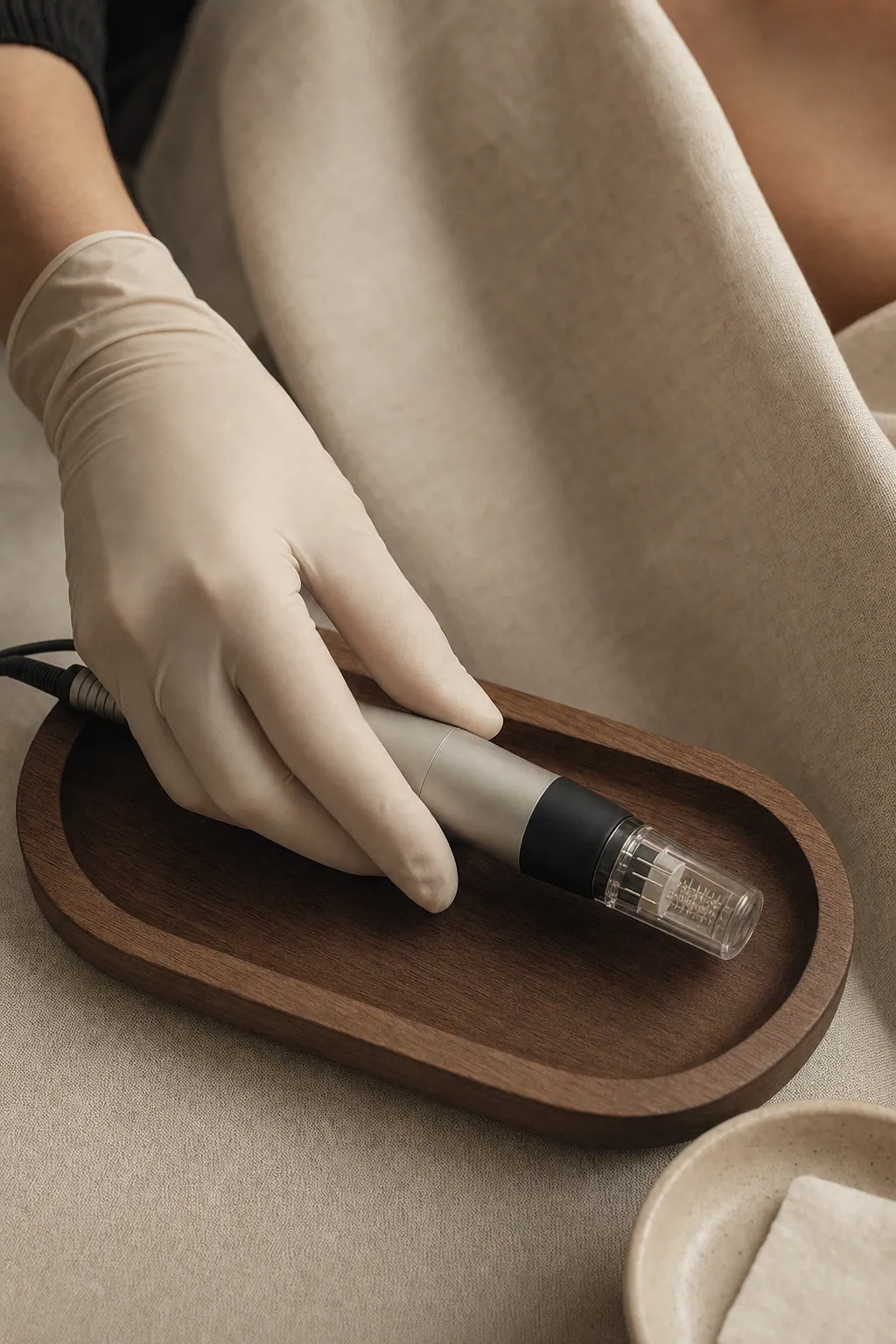
Microneedling with radiofrequency heat for mild laxity, acne scars, and large pores. How it compares with Morpheus8 and basic microneedling.
Melasma is a hormonal-and-UV chronic condition, not a spot to zap. Our conservative protocol, sun spots vs melasma, realistic outcomes.
PDL and Nd:YAG settings for telangiectasias, rosacea redness, post-inflammatory erythema and cherry angiomas.
Schedule a consultation for laser resurfacing. co₂ and er:yag for texture, pores, and skin laxity.
“I had ablative CO2 laser resurfacing. Next to no pain! … She explained everything in detail and was explicit in after care instructions…”