Laser hair removal — back, including coarse and dense hair.
Device selection for the back, session count, anagen-cycle timing, and pre-care that affects whether the session works.
No. Hair grows in cycles, and a single laser session only treats the hairs currently in the growth phase — typically a third of the follicles at any given time. The back is also a particularly dense, coarse area where six to eight sessions spaced four to six weeks apart is the realistic plan. Anything quicker isn't permanent.
The back is one body area within our full laser hair removal program — face, Brazilian, underarms, legs, and full-body courses all run from the Calabasas studio on the same cycle-timed structure. This page goes deep on the back specifically; the program overview and the full area menu live on the main laser hair removal page, linked below.
Dense, coarse, slow to finish.
Of the larger body areas we treat for hair removal, the back is the most demanding. Coarse hairs, high density across a wide area, and a follicle distribution that includes areas pulled by clothing and friction every day. The result is that the back rewards a careful device choice, longer sessions, and a patient willing to commit to the full cycle of treatments.
Most patients see meaningful reduction by the third session — the density visibly thins — but the area is not finished until the final session in the course, typically six to eight in. Skipping sessions or pushing intervals out by months at a time means re-recruiting hairs that have re-entered the growth cycle in the meantime.
Diode for most. Nd:YAG when the diode is wrong.
We classify Fitzpatrick at consultation and check hair color directly. The device choice follows.
| Diode laser · 810 nmOur default for the back | Strongly absorbed by melanin in dark hair. Works across Fitzpatrick I through IV with consistent results. Larger spot size and integrated chilled handpiece make it efficient on broad areas like the back — a full back session runs 45 to 75 minutes. |
|---|---|
| Long-pulse Nd:YAG · 1064 nmFor darker skin tones | Deeper penetration, less melanin absorption at the epidermis — the safer choice for Fitzpatrick V and VI where the diode risks unwanted pigment damage. Slightly more sensation per pulse; same number of sessions. |
| Not the right toolLight, blonde, red, or gray hair | All current laser hair removal devices target melanin. Hair without melanin doesn't absorb the energy. We'll tell you honestly at consultation if your hair color isn't a candidate, rather than book six sessions that won't work. |
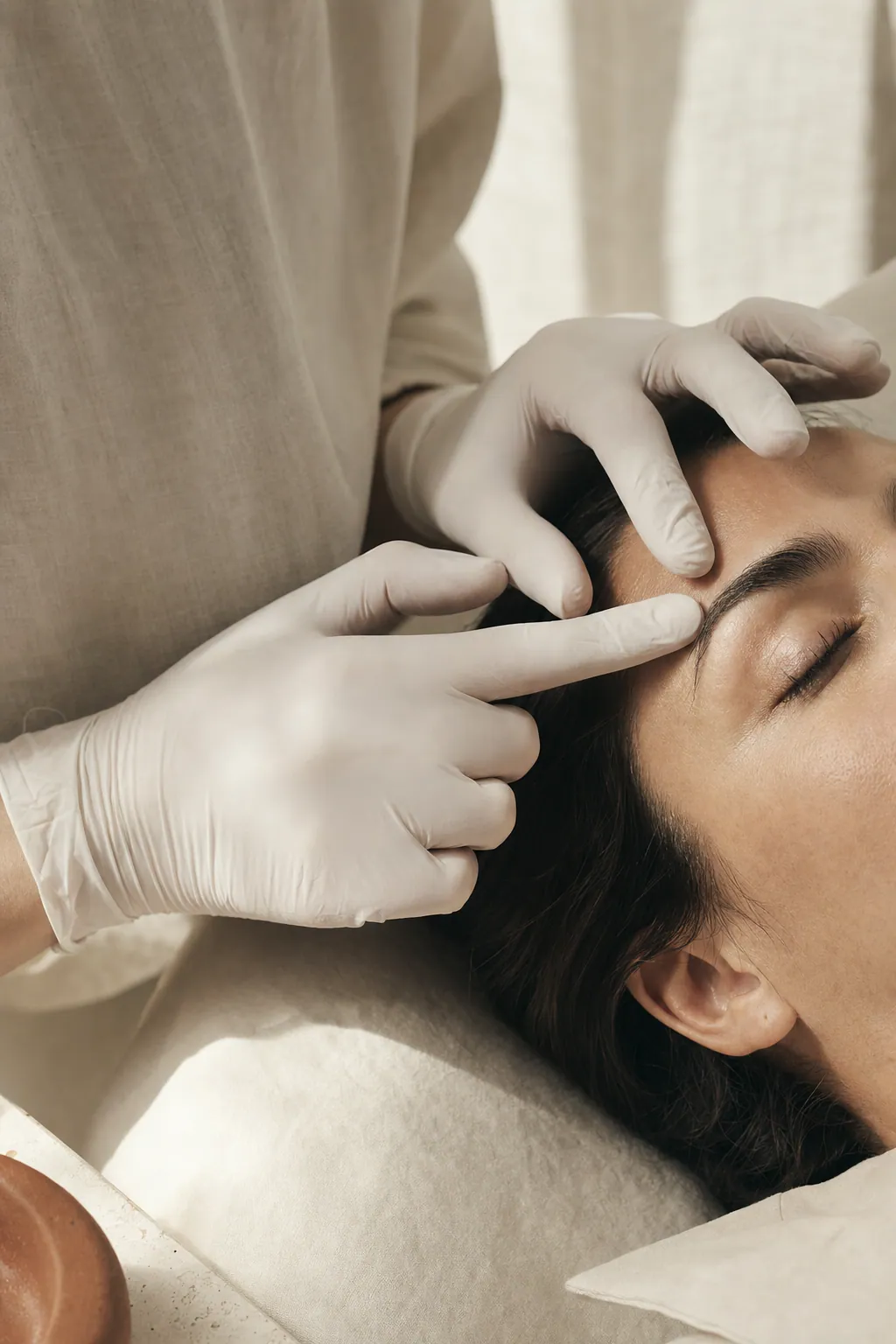
The week before matters as much as the session.
Shave the entire back the day before — not earlier, not later. The follicle should still contain the hair shaft below the surface; the surface hair should be gone so the laser energy reaches the follicle, not the visible strand. We re-shave any missed areas at the visit.
Do not wax, pluck, or thread for at least four weeks before any session. Removing the hair from the follicle defeats the laser; the follicle has to be there to be targeted. Bleaching the hair similarly removes the melanin that the laser needs.
No tanning, no sunless tanner, no significant sun exposure on the back for four weeks before — tanned skin and laser hair removal don't mix. We'll defer the session and reschedule.
On the cadence"The hairs you can see today aren't the hairs we'll treat at session three. Cycle timing is the protocol."
How a back appointment runs.
- 01
Arrival and re-shave.
We check that the area is cleanly shaved and address any missed sections. Photograph the baseline at the first visit; reference photos at sessions three and six.
- 02
Test pulse.
On the first session, a single test pulse on a small area at the planned settings. We wait a minute, check the skin response, and adjust before proceeding to the broader pass.
- 03
Pass.
Systematic pass across the back with the chilled handpiece. Sensation is a brief warm snap with each pulse. Most patients describe it as tolerable without topical numbing; topical is available for sensitive patients.
- 04
Aftercare.
Cool the area immediately after. Mild redness and perifollicular puffiness is normal for 12 to 48 hours. No hot showers, no gym, no sauna for 24 hours. Daily SPF on any uncovered skin for the next month.
Six to eight, four to six weeks apart.
The full course for a back is typically six to eight sessions spaced four to six weeks apart. Patients with hormonally driven hair growth (some PCOS presentations, some patients on testosterone therapy) often need more. Patients with finer hair and lower density can sometimes finish in five.
After the course, most patients return once or twice a year for a touch-up session on whatever density returns. This is normal — laser hair removal is permanent reduction, not permanent removal, and the FDA labeling reflects exactly that distinction.
- Tanned skin. Defer until the tan resolves — 4 to 6 weeks.
- Patients within 6 months of isotretinoin (Accutane).
- Active skin infection or open wounds in the treatment area.
- Pregnancy. We defer hair removal during pregnancy and breastfeeding.
- Hair that doesn't contain enough melanin to respond — no point in booking a course that physically can't work.
Supervised by Dr. Charles Peterson, board-certified physician with nearly a decade in aesthetic medicine.
Questions we get.
How much does back hair removal cost?
Per-session pricing depends on the surface area treated and whether you're combining the back with shoulders or upper arms. Multi-session packages are priced after the first one or two sessions, when the response is established. Pricing discussed at consultation.
Can I just shave between sessions?
Yes. Shaving between sessions is required, in fact — the surface should be clean for the next session. Waxing, plucking, and threading are what to avoid.
How long does a session take?
Full back: 45 to 75 minutes depending on density and whether you're combining adjacent areas. The first session runs longer because of the test pulse and the baseline documentation.
Will the hair come back?
Some hairs return over the years, particularly hormonally driven hair growth. Most patients are happy with one or two maintenance sessions a year after the initial course.
Does it work on dark skin?
Yes, with the long-pulse Nd:YAG. We classify Fitzpatrick at consultation and choose the device that's safe for your skin type.
Continue.
Laser hair removal near Calabasas — face, Brazilian, underarms, legs, back and full-body courses. Sessions, spacing, and skin-type fit.
Ablative resurfacing, pigment, vascular, RF, hair removal, tattoo and PMU removal — how we choose by concern, not by device.
Pores, fine lines, tone unevenness, crepiness and laxity — a layered approach using regenerative microneedling, lasers and peels.
Schedule a consultation for laser hair removal — back, including coarse and dense hair.
“I had ablative CO2 laser resurfacing. Next to no pain! … She explained everything in detail and was explicit in after care instructions…”