NAD+ injections.
What NAD+ is, what it does and doesn't do, IV vs injection vs oral comparison, dosing protocols, side effects.
NAD+ — nicotinamide adenine dinucleotide — is a coenzyme present in every cell, central to mitochondrial energy production and DNA repair. Levels decline with age, and there is genuine basic-science interest in NAD precursors and their effects on cellular function. The clinical evidence for injectable NAD+ in healthy adults is preliminary. We administer it for patients who understand that framing — not as a miracle for fatigue.
NAD+, in plain terms.
NAD+ is a coenzyme — a small molecule that enzymes need to function. It shuttles electrons in the mitochondrial respiratory chain, which is how cells extract energy from food. It also serves as substrate for sirtuins and PARPs, two protein families involved in DNA repair and metabolic regulation.
Tissue NAD+ levels decline with age in animal models, and a body of basic research has explored whether restoring those levels has clinical benefit. The work is genuinely interesting. The clinical evidence in healthy humans, for injectable NAD+ specifically, is still preliminary.
We offer NAD+ for patients who have read the case honestly and want to try it. We don't recommend it as a generic fix for fatigue or aging.
IV, IM, subcutaneous, oral — which when.
| Intravenous (IV)30 – 90 minutes · clinic visit | Highest bioavailability. The infusion is slow because rapid administration produces flushing, nausea, and a sense of chest tightness that resolves when the drip is paused or slowed. Most patients describe the slow drip as tolerable but unpleasant during the session. |
|---|---|
| Intramuscular (IM)Single injection · in and out | Smaller dose, faster visit. Bioavailability is meaningfully lower than IV, but the per-dose tolerability is better and the time commitment is minor. A reasonable maintenance route for patients who've responded well to IV. |
| Subcutaneous (SQ)Self-administered at home | Lower dose, dosed more frequently. For patients on an ongoing protocol who want fewer clinic visits. We train administration in office before authorizing home use. |
| Oral NAD precursorsNMN · NR · niacinamide | Oral nicotinamide riboside and nicotinamide mononucleotide are NAD precursors that the body converts to NAD+. The evidence for oral precursors raising tissue NAD+ levels is reasonably strong. Whether that's clinically equivalent to injection is unsettled. |
What an IV session actually feels like.
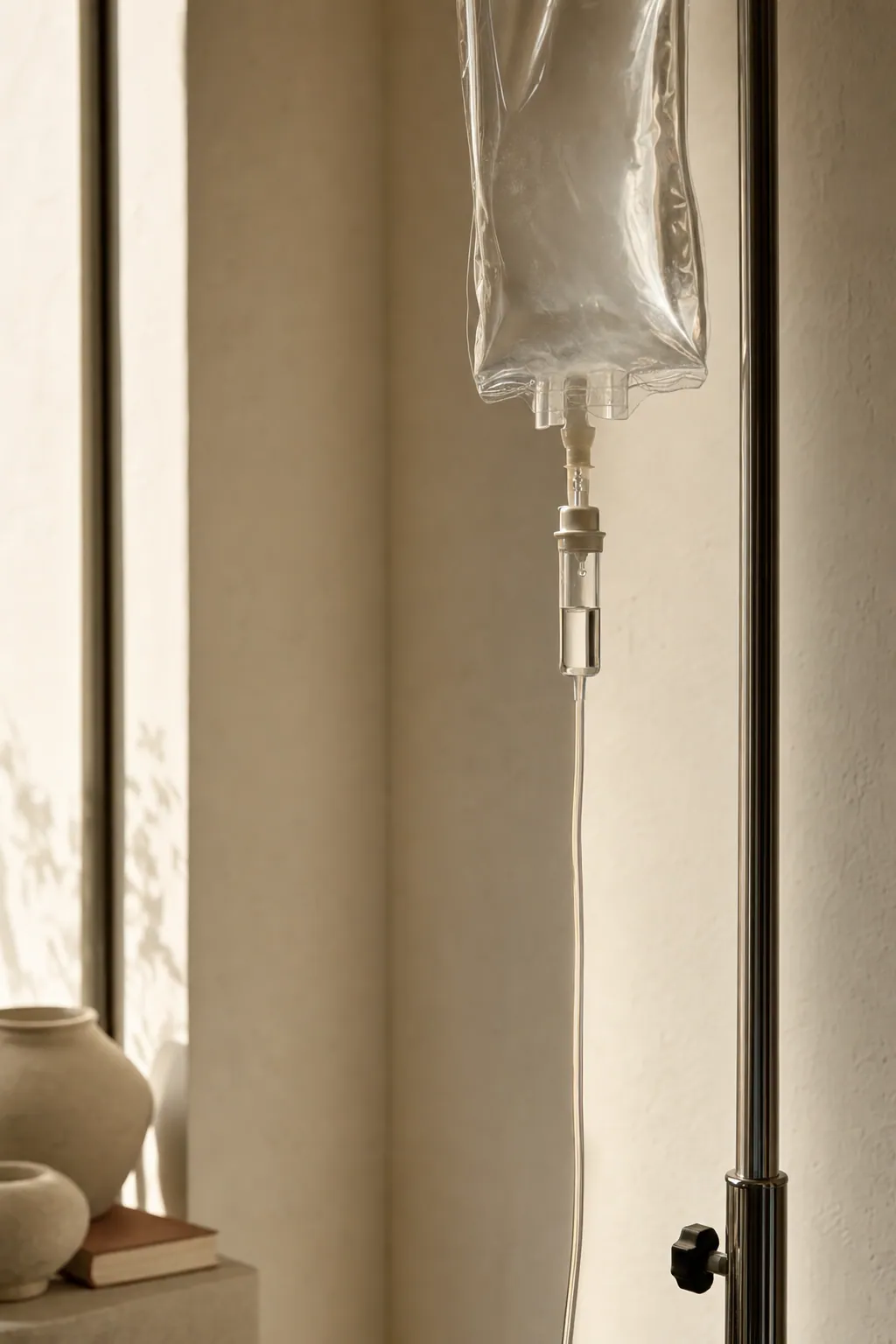
The first thirty minutes are usually fine. As the drip continues, most patients develop some combination of facial flushing, a sense of pressure or tightness in the chest, mild nausea, and occasional headache. None of these are dangerous; all are dose-rate dependent.
The intervention, when symptoms arise, is to slow the drip. Slower equals more comfortable. The trade-off is that a 500 mg infusion that takes 45 minutes at one rate may take 90 minutes at a more tolerable one — and we plan for that, rather than rushing through.
Patients vary in tolerance. Some sail through full doses without symptoms; others are uncomfortable from minute fifteen. We adjust to your physiology rather than assuming a protocol fits everyone.
Loading, then maintenance.
- 01
Loading phase.
Four to six IV infusions over the first two to three weeks, dose-titrated based on tolerability. The frequency front-loads the exposure for patients pursuing a clinical effect.
- 02
Re-assessment.
After the loading phase, we ask the obvious question — has anything changed? Patients who notice a meaningful difference move into maintenance. Patients who don't, stop.
- 03
Maintenance.
Typically monthly IM injections or less-frequent IV infusions. Some patients prefer subcutaneous home dosing once trained. The cadence is set by response and lifestyle.
On expectation"If we're honest, some patients describe a meaningful difference after the loading phase. Others don't. We re-assess at the end of the loading phase rather than committing to long-term protocols upfront."
- During pregnancy or breastfeeding.
- Patients with significant renal impairment.
- Patients with active cancer outside coordination with the treating oncologist (the mechanism interactions are non-trivial).
- Without screening labs when clinical context suggests they're warranted.
- At infusion rates that produce symptoms beyond mild discomfort — slow the drip first, every time.
Supervised by Dr. Charles Peterson, board-certified physician with nearly a decade in aesthetic medicine.
Questions we get.
Does NAD+ actually work?
Basic-science research on NAD biology is robust. Clinical research on injectable NAD+ in healthy adults is preliminary. We administer it for patients who want to try it with honest expectations, not as a guaranteed intervention.
Can I take an oral NMN or NR supplement instead?
Possibly. Oral NAD precursors raise tissue NAD+ levels in published studies. Whether that maps onto the same clinical effect as injection is unsettled. For some patients the oral route is the right starting point.
Why is the IV so uncomfortable?
Rapid NAD+ administration produces flushing, chest tightness, and nausea. These symptoms are dose-rate dependent and resolve when the drip slows. We plan infusions long rather than fast.
How long until I notice anything?
If a patient is going to notice a change, it usually appears during or shortly after the loading phase — within two to three weeks of starting. If nothing has changed by then, more sessions are unlikely to.


Schedule a consultation for nad+ injections.
“They're truly my one-stop shop for everything beauty and skincare. The entire team is so knowledgeable, honest, and always ready to help…”