PRP for hair restoration.
Growth factors injected into the scalp to stimulate dormant follicles. Candidacy, protocol, and the typical results timeline.
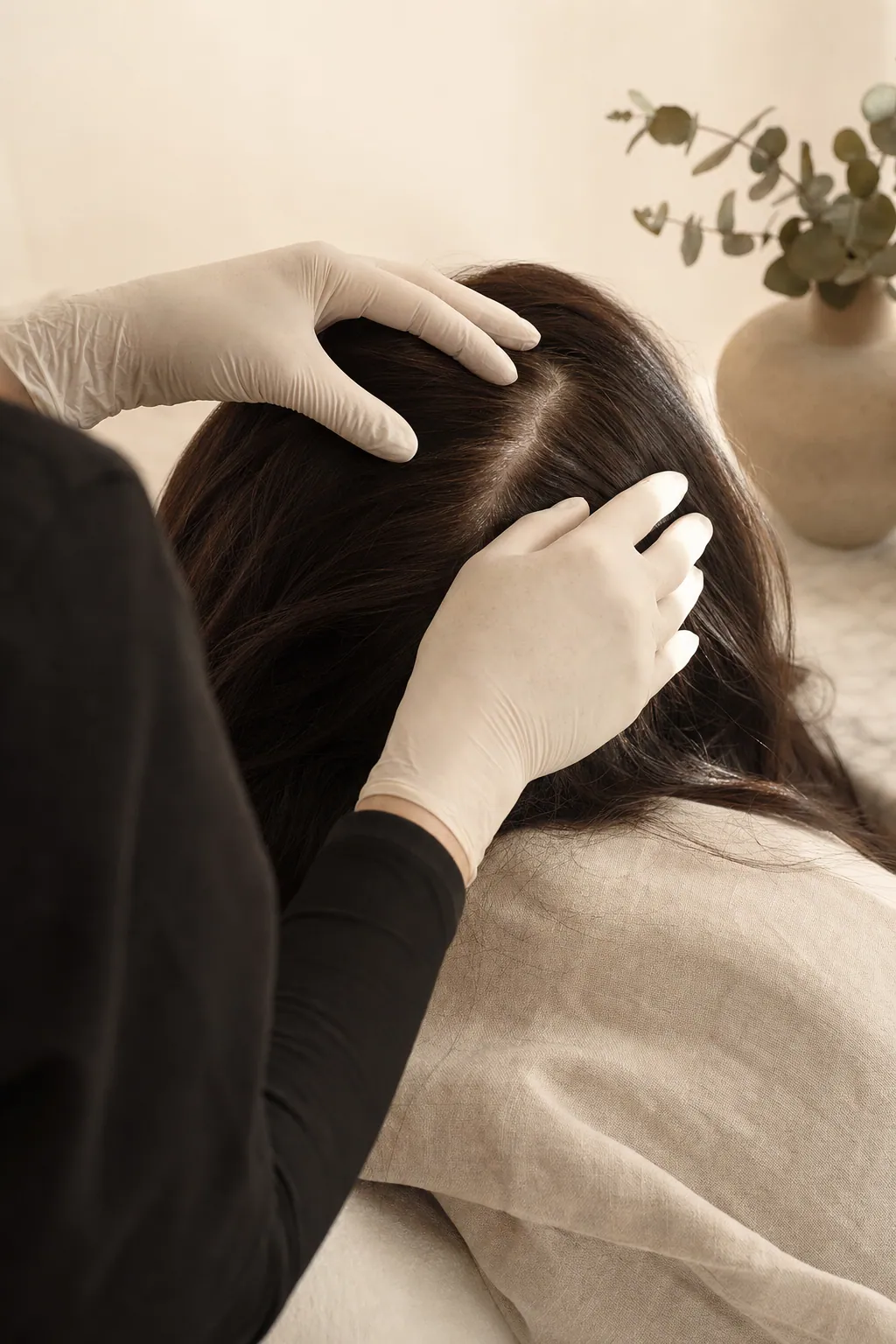
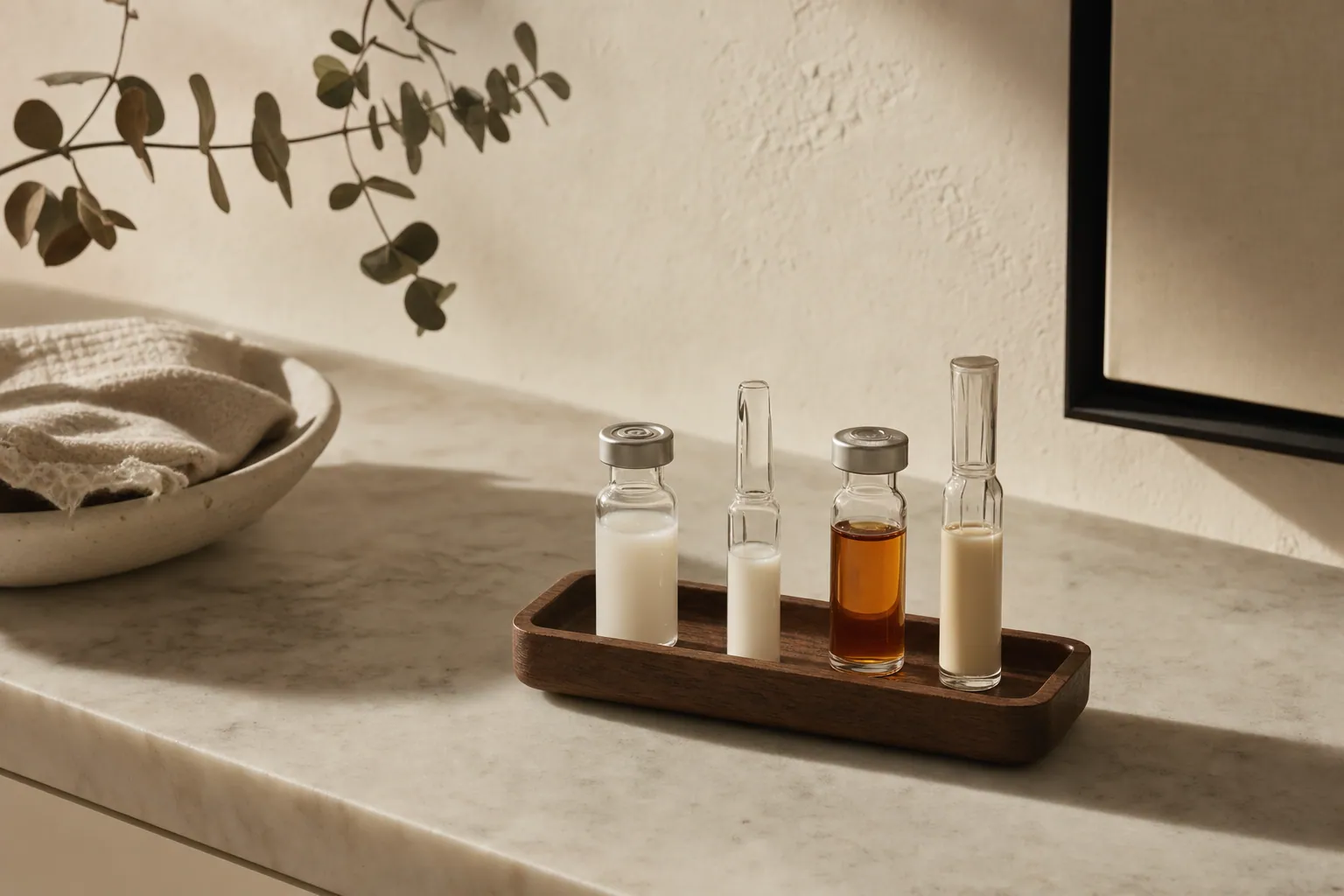
Platelet-rich plasma drawn from your own blood, spun in a centrifuge, and injected into the scalp at the level of the follicle. The growth factors released stimulate dormant follicles into a new growth phase. A series of three to four sessions over four months is the standard protocol; maintenance is annual.
Growth factors, from your own blood, into the scalp.
Hair loss has multiple drivers — genetics, hormones, stress, nutritional, post-partum, post-illness. Not every cause responds to PRP, and we are candid at the consultation about which kinds of loss the protocol is built for and which it is not.
The strongest evidence is in androgenetic alopecia (pattern thinning) caught relatively early, in telogen effluvium (diffuse shedding after a stressor), and in some forms of post-partum loss. PRP works by stimulating follicles that are present but underactive. Follicles that have miniaturized to the point of being inactive — or that are gone — do not respond.
The earlier a patient comes in after noticing change, the more we have to work with. Patients who have been thinning for a decade have a different conversation than patients in the first six months.
How a session goes.
- 01
Blood draw.
A standard venous draw, 15 to 30 mL depending on the area being treated. Same as a routine lab draw.
- 02
Centrifuge.
Twelve to fifteen minutes in a dedicated centrifuge that separates the platelet-rich layer. Filtered into syringes for injection.
- 03
Scalp prep and numbing.
Topical anesthesia for the scalp; some patients tolerate the session with light topical alone, others prefer a more substantial numbing protocol. Discussed at the first visit.
- 04
Injection.
Small aliquots of PRP delivered with a fine needle in a grid pattern across the affected scalp. 50 to 80 injection points over 15 to 25 minutes. Sensation is brief sting at each site.
- 05
Out the door.
No occlusive dressing. Avoid washing the scalp for six hours; resume your normal hair care the next day. Most patients return to work the same day.
What to expect, and when.
PRP does not produce visible regrowth on the day of the injection or the week after. The patient who arrives looking for instant change is the patient most likely to be disappointed.
The standard series is four sessions, four to six weeks apart. Patients commonly report reduced shedding by the second session. Early new growth — short, fine hairs along the part line or temples — typically becomes visible at three to four months. Substantial density change is a six-month milestone.
After the initial series we recommend a maintenance session every six to twelve months depending on the underlying driver. Patients with ongoing androgenetic activity benefit from closer maintenance; patients whose loss was a one-time event may need less.
Who PRP helps, and who it doesn't.
Best candidates: early-to-moderate androgenetic alopecia, recent post-partum or post-illness shedding, female-pattern thinning along the part, ongoing thinning despite topical minoxidil that the patient wants to support. Patients should be in general good health, with no active scalp infection or active autoimmune disease at the scalp.
Less ideal: long-standing total hair loss, scarring alopecia, frontal fibrosing alopecia, active alopecia areata. PRP is also not a substitute for transplantation when transplantation is the right call; some patients benefit from both in sequence and we coordinate referrals.
Conditions we screen for include bleeding disorders, anticoagulant medications, recent isotretinoin, and active steroid use. Some of these are not absolute contraindications but require coordination with your prescribing physician.
On expectations"PRP supports follicles that are still alive. It does not bring back what is gone. The patients who come in early do better than the patients who come in late."
What pairs well with PRP.
PRP is often part of a broader plan rather than the only intervention. Topical minoxidil, oral finasteride for appropriate patients under physician oversight, low-level laser therapy at home, and addressing the underlying driver (iron, ferritin, thyroid, hormones) all carry meaningful weight.
For patients who want maximum response, the protocol we most often recommend is medical management plus a four-session PRP series in year one, followed by maintenance sessions and ongoing medical management. Single modalities exist; combined plans tend to outperform them.
- Patients with active scalp infection, including bacterial folliculitis and tinea capitis.
- Patients with bleeding disorders or on therapeutic anticoagulation without coordinating with the prescribing physician.
- Patients with scarring alopecia at the scalp area being treated.
- During pregnancy or breastfeeding.
Performed by Orr Swissa-Amran, PA-C, board-certified Physician Associate, internationally trained in hair restoration and aesthetic medicine.
Questions we get.
How many sessions will I need?
The standard initial series is four sessions, four to six weeks apart, followed by maintenance every six to twelve months. Some patients respond strongly to three; some need a longer initial series.
Does it hurt?
The scalp is sensitive. Topical numbing handles most of it, and some patients add a more substantial pre-treatment numbing protocol on subsequent visits. The injection portion is 15 to 25 minutes.
How much does it cost?
Pricing is per session and depends on scalp area. Pricing discussed at consultation. Multi-session packages are common for the initial series.
When will I see new growth?
Reduced shedding by session two. Early new growth — fine, short hairs — visible at three to four months. Meaningful density change at six months. PRP is not a same-week result.
Is PRP the same as PRF for hair?
PRP is the standard for scalp hair restoration; PRF is more commonly used for under-eye and facial skin-quality work. The protocols are similar, the centrifuge spin and the resulting product differ.
Continue.
Collagen induction over months rather than instant fill — Sculptra, Radiesse, PRP, PRF, EZGel.
A surgical brow restoration combining Dr. Peterson's FUE training, Orr Swissa-Amran's medical execution, and Ruth Swissa's 25 years of eyebrow shape design.
Schedule a consultation for prp for hair restoration.
“They're truly my one-stop shop for everything beauty and skincare. The entire team is so knowledgeable, honest, and always ready to help…”